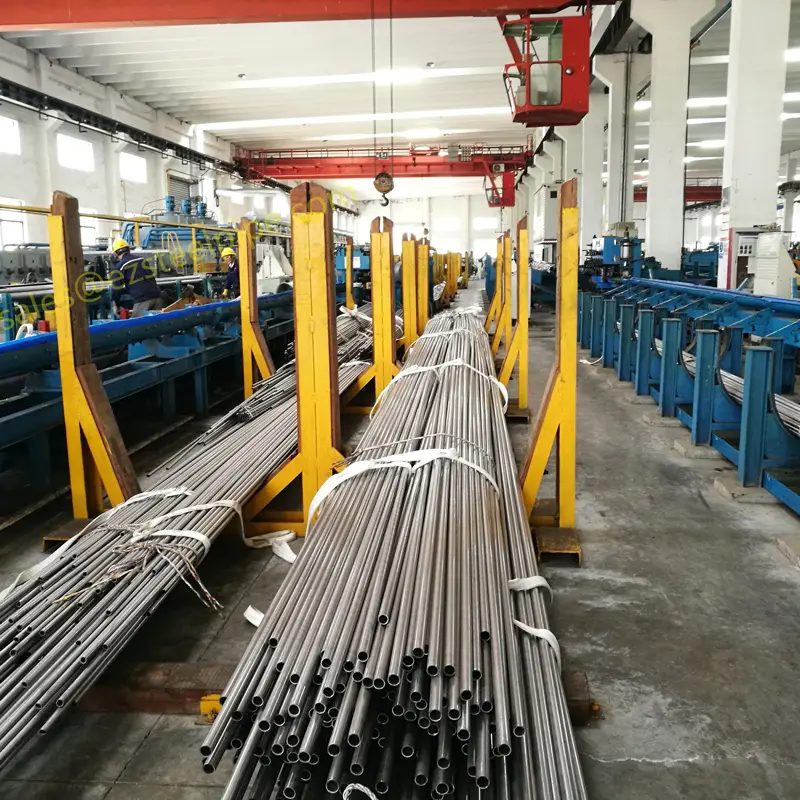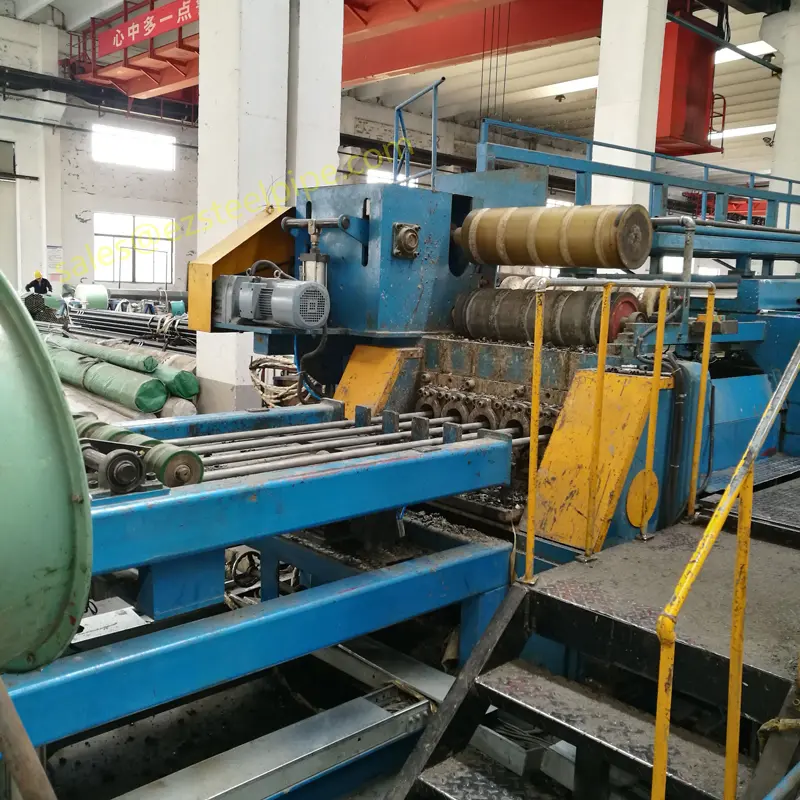
CE Certification EN 10216-2:2024 – Seamless Steel Tubes for Pressure Purposes – Technical Delivery Conditions – Part 2: Non-alloy and Alloy Steel Tubes with Specified Elevated Temperature Properties Supplier, Factories

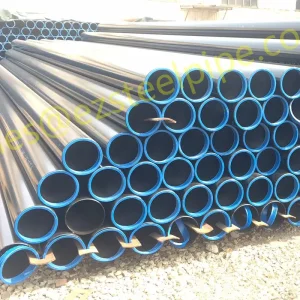
This European standard specifies requirements for seamless steel tubes used in pressure equipment at elevated temperatures, covering non-alloy and alloy steels. The latest version (2024) includes updates to material grades, testing, and inspection procedures.  

Scope  
- Applies to seamless tubes for boilers, heat exchangers, and pressure vessels.  
- Covers non-alloy (P195GH, P235GH, etc.) and alloy steels (16Mo3, 13CrMo4-5, etc.).  
- Suitable for high-temperature service (creep-resistant steels).

Product Description

Ordering Information

Purchasers must specify:

  • Quantity (length, number of tubes)
  • Material designation (e.g., P235GH, 13CrMo4-5)
  • Dimensions (outer diameter, wall thickness, length)
  • Delivery condition (e.g., normalized, tempered)
  • Testing requirements (e.g., impact testing, NDT)
  • Inspection documents (e.g., EN 10204 Type 3.1 or 3.2)
  • Special requirements (e.g., hydrogen compatibility, additional tests)

Material Grades & Chemical Composition

Non-Alloy Steels (for Elevated Temp Service)

Grade C (max) Mn Si P (max) S (max)
P195GH0.13%0.40-1.20%≤0.40%0.025%0.015%
P235GH0.16%0.60-1.20%≤0.35%0.025%0.015%
P265GH0.20%0.80-1.40%≤0.40%0.025%0.015%

Alloy Steels (Cr-Mo & Heat-Resistant Grades)

Grade C Cr Mo Other
16Mo30.12-0.20%-0.25-0.35%-
13CrMo4-50.08-0.18%0.70-1.15%0.40-0.60%-
X10CrMoVNb9-1 (P91)0.08-0.12%8.0-9.5%0.85-1.05%V, Nb

Mechanical Properties

Room Temperature Requirements

Grade Yield Strength (MPa) Tensile Strength (MPa) Elongation (%)
P235GH≥235360-510≥25
16Mo3≥270450-600≥22
13CrMo4-5≥280460-640≥20

Elevated Temperature Properties

  • Creep resistance data provided for long-term high-temp service.
  • Impact testing required for certain grades (e.g., -20°C or -50°C).

Test Requirements

Mandatory Tests

  • Tensile test (per EN ISO 6892-1)
  • Hydrostatic test (or non-destructive testing (NDT) if agreed)
  • Flattening test / Bend test (for certain sizes)
  • Impact test (if specified, per EN ISO 148-1)

Optional Tests

  • Ultrasonic testing (UT) or eddy current testing (ET)
  • Grain size analysis
  • High-temperature tensile testing
  • Hardness testing

Inspection & Certification

  • EN 10204 Type 3.1 (mandatory) – Manufacturer’s self-certification.
  • EN 10204 Type 3.2 (if required) – Independent inspection.
  • Traceability (heat number, manufacturing process).

Marking & Surface Condition

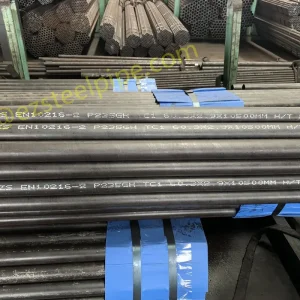
  • Permanent marking: Grade, size, manufacturer, heat number, standard.
  • Surface finish: Free from defects affecting performance.

Supplementary Requirements

  • S1: Special cleanliness (e.g., for hydrogen service).
  • S2: Additional NDT (e.g., full-body ultrasonic testing).
  • S3: Specific heat treatment conditions.

Key Applications

  • Power plants (boiler tubes, super-heaters)
  • Oil & gas (pressure vessels, heat exchangers)
  • Chemical industry (high-temp piping)

Major Steel Grades & Category

Non-Alloy Steel Grades

GradeSimilar toKey Characteristics
P195GHLow-carbon, general-purpose
P235GHASTM A106 Gr.BStandard boiler/pipe steel
P265GHHigher strength than P235GH

Molybdenum (Mo) Steels

GradeSimilar to ASTMAlloy Composition
16Mo3A335 P1 / A209 T1a0.3% Mo (low-alloy)
20Mo4Higher Mo than 16Mo3

Chromium-Molybdenum (Cr-Mo) Steels

GradeSimilar to ASTMAlloy Composition
13CrMo4-5A335 P12 / A213 T121% Cr-0.5% Mo
10CrMo5-51% Cr-0.5% Mo (variant)
10CrMo9-10A335 P22 / A213 T222.25% Cr-1% Mo
X11CrMo55% Cr-0.5% Mo
X11CrMo9-1A335 P9 / A213 T99% Cr-1% Mo

Advanced High-Temperature Steels

GradeSimilar to ASTMAlloy Composition
X10CrMoVNb9-1 (P91)A335 P91 / A213 T919% Cr-1% Mo-V-Nb
X11CrMoWVNb9-1-1A335 P929% Cr-2% W-1% Mo-V-Nb

Key Notes

1. Non-alloy grades (P195GH, P235GH, P265GH) are used for moderate temperatures (up to ~450°C).

2. Cr-Mo grades (13CrMo4-5, 10CrMo9-10, etc.) are for high-temperature creep resistance (e.g., power plants).

3. P91/P92 grades are for ultra-supercritical (USC) boilers (600°C+).

4. Stainless grades (X6CrNiNb18-10) are for corrosion-resistant high-temp applications.
Comparison with ASTM Standards

  • EN 10216-2 X10CrMoVNb9-1 ≈ ASTM A335 P91
  • EN 10216-2 13CrMo4-5 ≈ ASTM A335 P12
  • EN 10216-2 10CrMo9-10 ≈ ASTM A335 P22

Frequently Asked Questions (FAQ)

Q1: What is the main application of EN 10216-2 seamless steel tubes? A: These tubes are primarily used for pressure purposes at elevated temperatures, such as in boiler installations, power plant piping, and heat exchangers.
Q2: What are the common material grades for high-temperature service? A: Common grades include non-alloy steels like P235GH and P265GH for moderate heat, and alloy steels like 16Mo3, 13CrMo4-5, and P91 for higher temperature and creep resistance.
Q3: Are these tubes compatible with ASTM standards? A: Yes, many EN 10216-2 grades have equivalents in ASTM. For example, P235GH is similar to ASTM A106 Gr.B, and X10CrMoVNb9-1 is equivalent to ASTM A335 P91.
Q4: What kind of testing is mandatory for EN 10216-2 tubes? A: Mandatory tests include tensile testing, hydrostatic testing (or NDT), and flattening or bend tests depending on the size and grade.
Q5: What certification is required for these products? A: Products must be supplied with inspection documents according to EN 10204, typically Type 3.1 (manufacturer's certification) or Type 3.2 (independent inspection).
Q6: What is the temperature limit for non-alloy grades like P265GH? A: Non-alloy grades are typically suitable for service temperatures up to approximately 450°C. For higher temperatures, alloy steels are recommended.

Related Products